
How Credits are Evaluated for Calculation
Based on an order item being processed in Xactly Incent, the application evaluates
two types of credits, if present:
• Direct Credits
• Indirect Credits
Direct Credits
Direct credits are calculated for the primary Person(s) on an the order item. Note
that an order item can contain multiple people and a direct credit can be shared
between several people.
Indirect Credits
Indirect credits are calculated based on direct credits and relationships, and are
granted to additional persons who have a relationship with the primary person
associated with an order.
When setting up an indirect credit rule, you specify the Position Relationship that
determines who else is eligible to share the credit. For more information about indirect credit rules, see Rules Library in the Xactly Incent Reference Guide.
A relationship that allows for an indirect credit can be based on any of the following:
• Indirect Credit Based on Reporting Hierarchy
• Indirect Credit Based on a Defined Relationship
• Indirect Credit Based on a Related Order (Person)
• Indirect Credit Based on a Related Order (Position)
Effective dating, in which there can be multiple contiguous versions of a Person/
Position relationship, can also affect calculation results. For more information, see
How Effective Dating Affects Calculation in the Effective Dating chapter.
Indirect Credit Based on Reporting Hierarchy
This type of indirect credit is granted based on the reporting hierarchy defined for
your organization. For example, Bob is Western Region Director, and has an indirect
credit rule in his plan that grants him an indirect credit, based on reporting
position relationships, every time a rollable credit is generated in his region.
The parameters of this rule are:
• Rule Type: Indirect Credit
• Position Relationship: Reporting
• Results are defined as:
• Result Name: Indirect Manager Credit
• Value: IndirectCredit – which is a formula (Credit.Amount)
• Value UnitType: USD
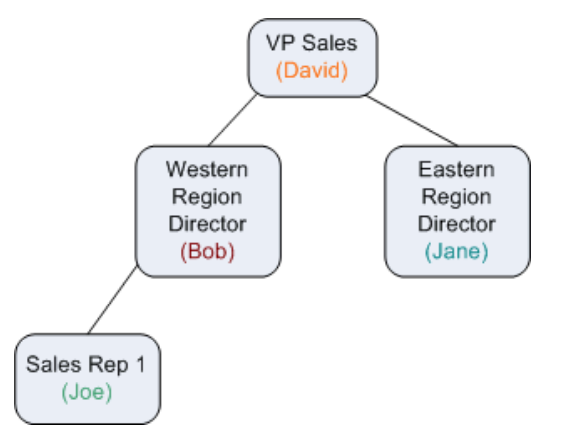
The following occurs when anyone in the Western Region generates a credit
based on an order being processed:
• An indirect credit rule exists for the Western Region Director (Bob).
• Bob gets an indirect credit when Joe receives a direct credit.
Indirect Credit Based on a Defined Relationship
How relationships are set up between people in your company affects how credit
rules are applied, and how people in your company’s hierarchy share compensation.
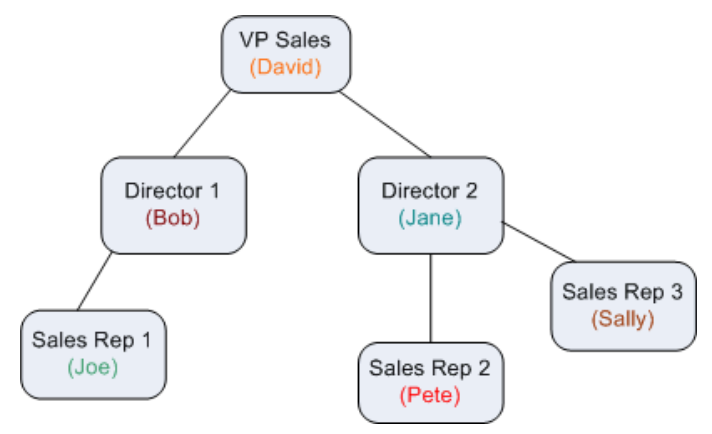
In the following example, two reporting relationships exist:
• Relationship A—In the company hierarchy, Director 1 (Bob) has a defined relationship
with Sales Rep 2 (Pete) and with Director 2 (Jane).
• Relationship B—Sales Rep 1 (Joe) has a defined relationship with Sales Rep 3
(Sally).

The following occurs when an order item assigned to Joe is processed:
• A direct credit rule exists in the Joe’s plan that is defined as both Rollable on
Reporting and Rollable.
• Indirect credit rules exist for Director 1 (Bob), the VP of Sales (David), and Sales Rep 3 (Sally).
• When the Rollable box is checked, credits are issued per order item and per
relationship type. Because of hierarchical rollup, Director 1 (Bob) and the VP of
Sales (David) share in the credit. Because of Relationship B, Sally also shares in
the credit.
• When Rollable on Reporting is checked, Director 2 and Pete also share in the
credit because of their defined relationships with Director 1 (Relationship A).
Indirect Credit Based on a Related Order (Person)
An indirect credit based on a related order (person) lets you grant an indirect
credit on a new order for people who received an indirect credit on an historic
order. You can specify this type of related order in the Related Order Code and
Related Item Code sections of the current order.
In this example, rules are set up as follows:
• Joe has a direct credit rule in his plan for both New and Clawback (chargeback)
order types that have the same credit type assignment.
• Bob and David have an indirect credit rule for new orders based on the reporting
relationship.
• Bob and David have another indirect credit rule for Clawback orders based
on the Related Order relationship.
Orders are processed as follows:
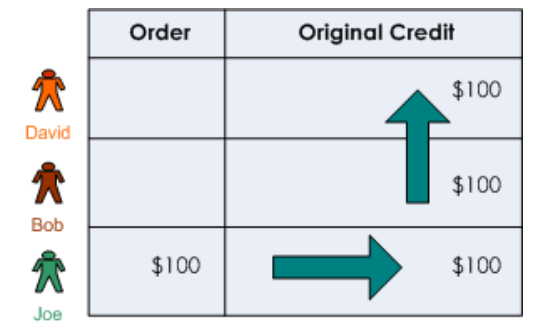
• A new order (Order1) is processed based on a direct credit to Joe (Position:
Sales Rep 1), and with an indirect credit based on Reporting to Bob and
David.
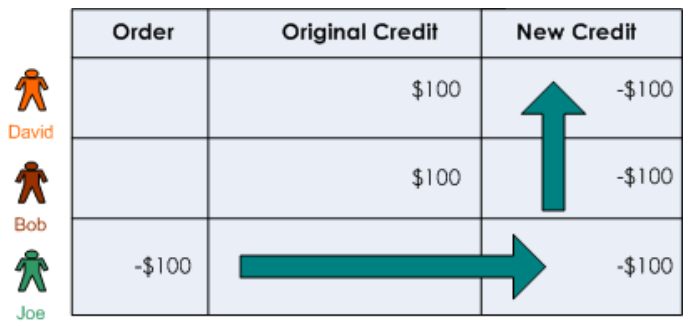
• A new order (Order2) with order type Clawback and related order Order1 is
processed with a direct credit to Joe (Position: Sales Rep 1) and with an indirect
credit based on Related Order (Person) to Bob (Position: Director 1) and
David (Position: VP Sales).
Indirect Credit Based on a Related Order (Position)
A relationship based on a related order (position) is defined by the person in the
specified position at the time the database is being processed. The indirect credit
goes to the person associated with the position. For example, when Sam with an
Indirect Credit (Reporting) is moved out of a position, Pete is moved into the position.
Pete has an Indirect Credit rule—Related Order (Position), which ties him to the
position. Any indirect credits granted will go to Pete because he is the person
associated with the position.